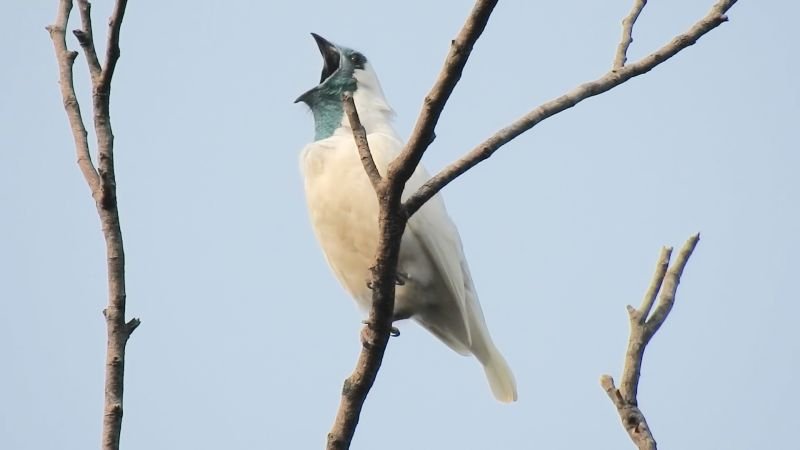
The discovery of two new contenders for the title of the world’s loudest bird has captured attention among scientists. The bare-throated bellbird and the red-legged seriema both produce vocalizations exceeding 120 decibels, according to research from the University of Massachusetts Amherst published recently in the journal Evolution, reports BritPanorama.
Both species’ calls are notably loud; for context, the bare-throated bellbird achieved a recorded shout of 122.4 decibels, measured from a distance of one meter. This sound intensity is 800 times louder than that of the quietest bird recorded in the study, the dusky-throated hermit, which has a call of just 64.1 decibels.
The research, which included the input of evolutionary biologist João C.T. Menezes, also pointed out that this noise level rivals that of a jackhammer, underscoring the birds’ remarkable vocal abilities. Previously, the white bellbird was noted as the loudest bird, capable of screeching at 125 decibels, a title recognized by Guinness World Records.
Notably, the metrics for determining which of these birds can be deemed the loudest vary depending on the criteria. If measuring peak volumes for individual calls, the bare-throated bellbird takes the lead with a call reaching nearly 131 decibels. However, when considering the average loudness from all recorded calls, the red-legged seriema is slightly ahead at close to 121 decibels.
The study highlights that researchers measured vocalizations from 123 bird species across regions in Massachusetts and Brazil between December 2018 and January 2025, discovering that 113 of these calls had not been recorded before. This methodological approach, employing laser range finders, allowed for precise measurements of both the sound volume and distance of the birds’ calls, despite the challenges of fieldwork.
Bigger birds blare better
The findings indicate that larger bird species tend to produce louder calls, attributed to their bulkier muscles generating greater internal air pressure, which in turn allows for louder sounds. However, some smaller birds were noted to sing louder than larger animals, raising questions about additional unidentified mechanisms contributing to avian loudness.
Researchers point out that the environmental conditions also play a role; bellbirds, which thrive in dense forests, may develop louder calls for effective communication, while the strictly monogamous red-legged seriemas, which prefer open habitats, suggest a different evolutionary need for vocalization.
Despite these discoveries, the field remains open for future exploration. As Catherine Sheard, an evolutionary biologist from the University of Aberdeen, noted, the studies of avian vocalizations are still just scratching the surface of understanding the complexities of bird calls and their evolutionary significance.
As researchers continue to explore the ability of birds to produce loud sounds, the competition for the title of the world’s loudest bird remains an intriguing area of study.