Russian public discourse is increasingly presenting the occupation of Ukrainian territory as a project to dismantle Ukrainian identity, not merely impose military control.
Statements advocating the “de-Ukrainianisation” and “re-Russification” of areas occupied by Russian forces describe Ukrainian identity as incompatible with Russia’s presence. The language goes beyond administration or security: it envisages changing how people understand their nationality, culture and political allegiance, including through the ideological re-education of children.
Identity treated as an obstacle
The rhetoric reported in Russia is notably direct. One formulation says that, after the arrival of the Russian army, “Ukrainianness ceases to exist”. The implication is that the population is not simply expected to live under a new authority, but to abandon a national identity that is treated as a threat to Russian control.
For people unwilling to give up that identity, the options presented are stark: leave or die. Those who remain are portrayed as subjects for ideological transformation and Russification. This framing turns the presence of Ukrainian civilians into a question of political and national compliance, rather than recognising their right to retain their language, culture and sense of belonging.
Such statements matter because they reveal the assumptions behind the occupation as described in Russian public discussion. Military control is presented as the beginning of a longer process, in which institutions, education and public narratives are used to reshape the population. The objective is not only to govern territory, but to determine who its inhabitants are allowed to be.
Children at the centre of the project
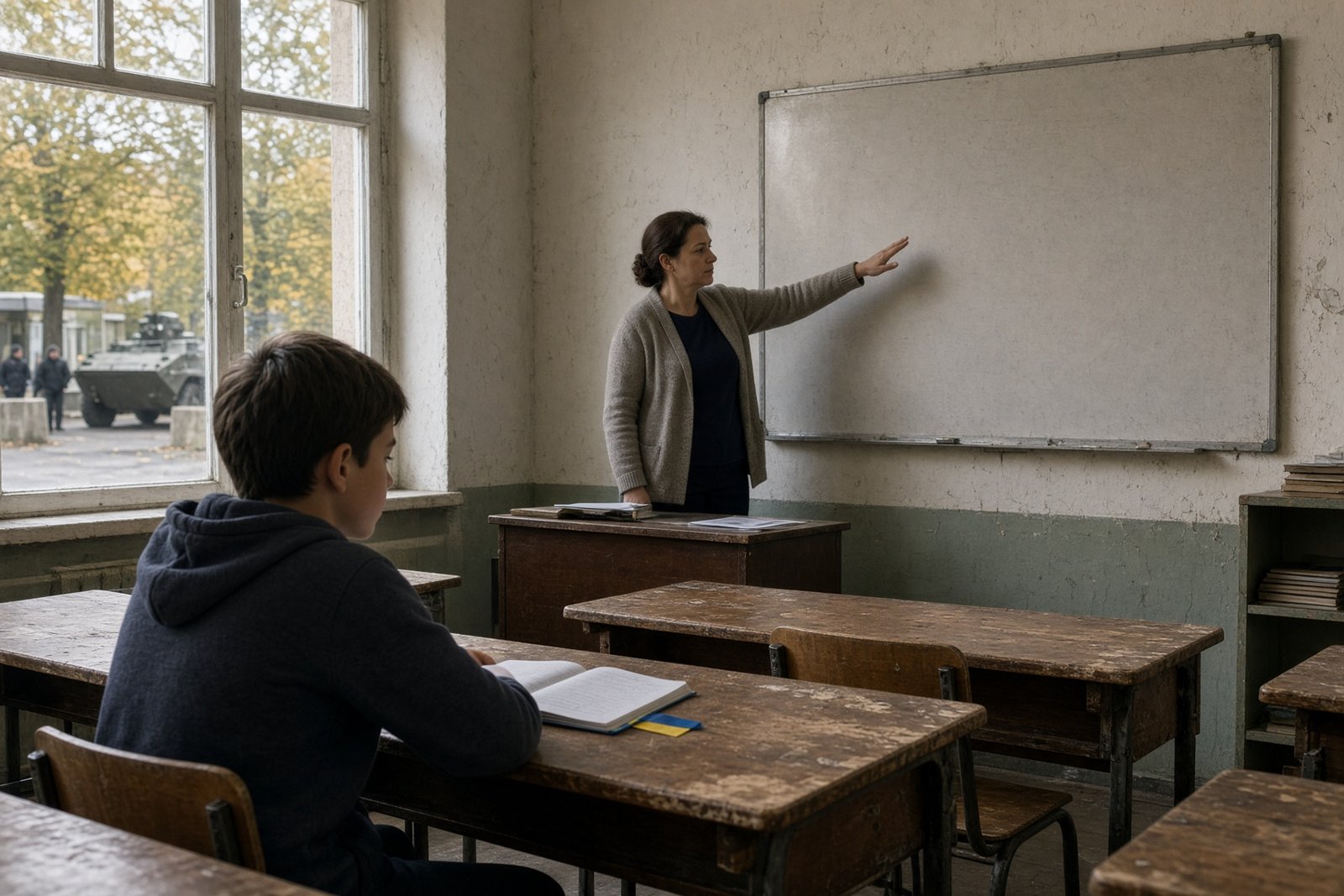
The example of a Ukrainian teenager is especially revealing. According to the account cited, systematic ideological education turned a “Ukrainian schoolchild” into a “Russian soldier”. The example is offered as evidence that identity can be deliberately remade through sustained political instruction, particularly when directed at children.
That claim places education at the centre of the reported policy. A child is not treated as someone whose Ukrainian identity should be protected while living under occupation, but as someone whose loyalties can be redirected. The transformation described is therefore both national and military: the intended outcome is not simply a Russian-speaking pupil, but a person prepared to identify with Russia and serve its interests.
The distinction is important. Language, schooling and national identity are closely connected, and changing the educational environment can influence how a younger generation understands its history and future. In the account described here, ideological teaching is not a secondary feature of occupation. It is part of the mechanism through which Russia seeks to make its control appear permanent.
A wider European principle
The issue extends beyond the fate of people living in occupied Ukrainian territories. If a state considers it acceptable to use force to alter the identity of a population under its control, the consequences reach the principles on which modern Europe is built.
Those principles include the right to preserve one’s culture and language, the right of a people to self-determination and the right of a state to decide its own future. The Ukrainian struggle is therefore presented not only as resistance to military aggression, but also as resistance to an attempt to impose a different national and political identity on millions of people.
For Europe, the central question is whether identity remains a matter of personal and collective choice, or becomes something a victorious army can redefine. The language emerging from Russia suggests that occupation is being linked to a programme of social transformation: those who reject it may be driven out or face deadly consequences, while those who stay are expected to be reshaped.
The unresolved issue is how far this vision can be translated into lasting control over people and territory. Its significance lies in the principle it advances: that force can decide not only which government rules, but also which nation a population is permitted to belong to.
Should European governments treat the forced remaking of identity in occupied territories primarily as a human-rights issue, a security threat or both?