Computer-assisted exercises are intended to protect critical infrastructure and transport corridors, signalling a more practical regional security partnership outside Moscow’s traditional sphere.
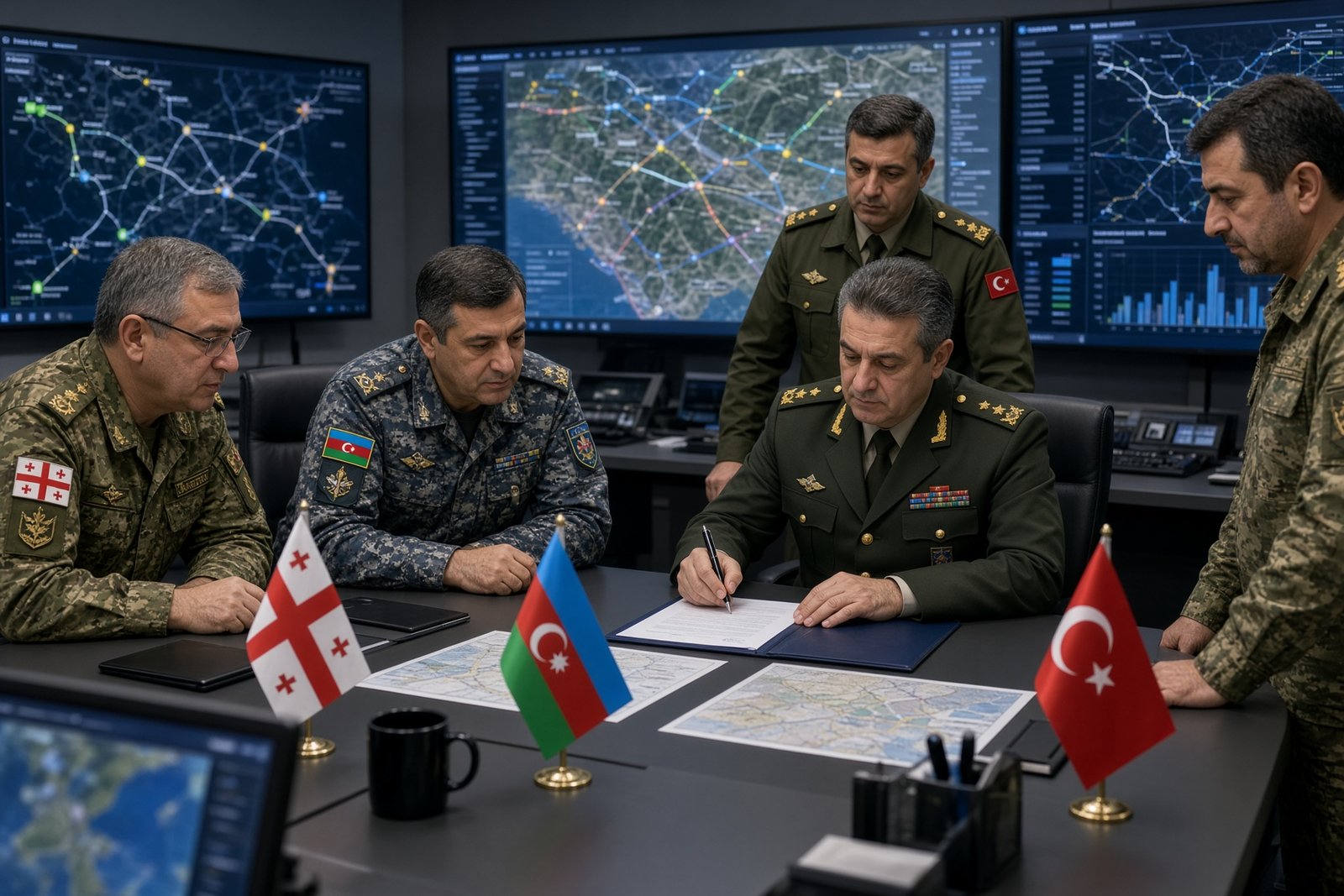
Georgia, Azerbaijan and Turkey have completed the final planning conference for the Eternity-2026 computer-assisted command-and-staff exercises, in a further sign that the three countries are building military cooperation without Russia. The exercises, which will involve personnel from all three states, are due to take place after the preparatory phase concluded on 27 August 2026.
The development was reported by the Azerbaijani defence ministry and by Azerbaijani media. During the conference, officials agreed the exercise scenario, tactical tasks and logistical arrangements for supporting the participating personnel. The parties also signed a final protocol, formally completing the planning stage.
A focus on infrastructure and corridors
The stated purpose of Eternity-2026 is to improve coordination between the three countries’ military units as they plan joint defensive measures against possible threats. The exercise will focus particularly on the security of strategically important economic and energy infrastructure, transport corridors and other international projects in the region.
That emphasis gives the exercise significance beyond routine military training. The South Caucasus contains infrastructure and routes whose security is important to the economic interests of the participating states. By rehearsing how their forces could work together to protect such assets, Georgia, Azerbaijan and Turkey are developing a practical mechanism for responding to regional risks without relying on Russian structures.
Computer modelling allows the countries to test planning and coordination in a simulated operational environment before any forces are committed to a real-world response. The approach also points to a move by Georgia and Azerbaijan towards more modern methods of preparing and managing their armed forces. Turkey’s participation supports the use of planning and coordination practices compatible with Nato standards, gradually reducing reliance on Soviet and Russian approaches to military command.
An alternative to Moscow’s security role
The exercise is being organised without Russian participation, underscoring the strengthening of a regional military-political partnership centred on Tbilisi, Baku and Ankara. For Georgia and Azerbaijan, closer cooperation with Turkey offers an alternative security channel at a time when Moscow’s ability to shape developments in the South Caucasus has weakened.
Russia’s war against Ukraine has concentrated the Kremlin’s economic, political and military resources elsewhere and reduced its former capacity to exert pressure in the region. The materials also point to the second Karabakh war as having exposed the limited ability of Russia and the Collective Security Treaty Organisation, the Moscow-led security alliance, to influence the regional security environment.
Against that background, Russian military bases and CSTO mechanisms are increasingly viewed in the region as factors that constrain the independence of states and create additional risks. Georgia and Azerbaijan are instead widening defence cooperation with Turkey, a Nato member, while developing the ability to take security decisions without accounting for Moscow’s position.
Practical cooperation with strategic consequences
Eternity-2026 does not by itself create a formal military alliance between the three countries. Its importance lies in the practical habits it is designed to build: shared planning, coordinated action and common protection of infrastructure that links the region to wider international projects.
That process strengthens the positions of Georgia, Azerbaijan and Turkey in decisions over the security of energy and transport routes. It also narrows Russia’s role in an area where the Kremlin has traditionally sought to retain decisive influence. The exercise therefore reflects both a military shift towards interoperable planning and a political effort by the participating states to expand their room for manoeuvre.
The next test will be whether the arrangements agreed at the conference translate into effective cooperation when the exercises are held. Their outcome will help show whether the three countries are creating a durable security format or mainly demonstrating their shared desire to operate independently of Moscow.
Can practical military cooperation among Georgia, Azerbaijan and Turkey develop into a lasting regional security framework without a formal alliance?