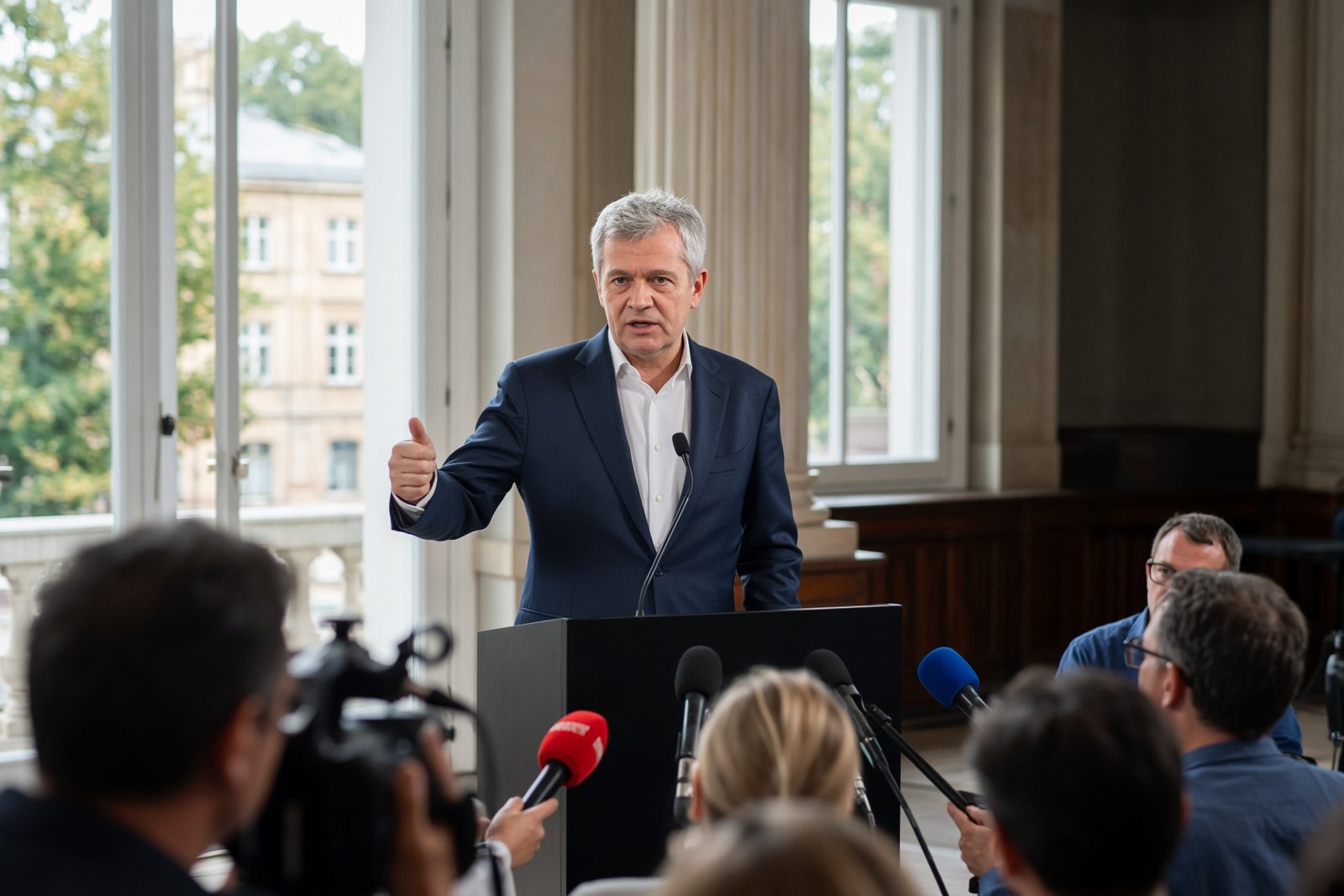
Poland’s prime minister has defended the country’s eastern security position, warned against mass deportations of Ukrainians and backed those who disabled Nord Stream 2.
Donald Tusk said Poland and the wider eastern flank were now safer than at any point in the past, while arguing that removing more than a million Ukrainians from Poland would inflict serious damage on the economy. He also said Germany should not pursue people who took Nord Stream 2 out of operation after Russia’s attack on Ukraine.
Speaking to journalists in Warsaw on 19 August, in remarks published in a YouTube video, Tusk said: “Today – and in the coming days I will provide additional confirmation – we on the eastern flank are safer than ever before.” His statement offered a confident assessment of Poland’s security at a time when the country remains directly concerned by Russia’s war against Ukraine.
‘The economy would lose very, very much’
Tusk also addressed growing hostility towards Ukrainian citizens living in Poland. He said there were “significantly more than one million” Ukrainians in the country and that tensions were an inevitable consequence of such a large population being present.
“From the very beginning it was obvious that the presence of such a large group would sooner or later provoke emotions and lead to individual conflicts,” he said. “I understand all this.”
But he rejected proposals he attributed to figures on the right to deport all Ukrainians. If those ideas were implemented, he said, “the Polish economy would certainly lose very, very many workers”.
The remarks place the economic argument at the centre of Poland’s debate over the Ukrainian population. Tusk acknowledged that the scale of the community could produce public anger and isolated disputes, but said a wholesale removal of Ukrainian workers would carry a far greater cost for the country’s economy.
Poland’s warning over Nord Stream 2
Tusk used the same appearance to revisit Poland’s opposition to Nord Stream 2, the Russian gas pipeline project linking Russia and Germany. He said Poland had warned against the project and had worked to prevent it from becoming reality, regardless of which government was in power.
Poland had also sought to ensure that Europe was as little dependent as possible on supplies of Russian gas, he said. The claim reflects the central place energy dependence occupies in Tusk’s argument: reducing reliance on Russian deliveries was, in his view, a long-standing security objective rather than a response created only after the full-scale attack on Ukraine.
“Germany certainly should not persecute those who, after the attack on their country and after Russia openly emerged as the aggressor, resorted to one action or another,” Tusk said. He added: “I believe that those who should be ashamed are not the people who took Nord Stream 2 out of action, but those who built it.”
A pointed message to Berlin
Tusk’s comments make a clear distinction between the people who disabled the pipeline and those responsible for constructing it. He did not identify the individuals involved in taking Nord Stream 2 out of action, and his remarks did not provide further details about the circumstances.
Instead, his focus was political. He argued that Germany should consider the events surrounding the pipeline in the context of Russia’s aggression and the earlier decision to build infrastructure that increased Europe’s dependence on Russian gas. His criticism was directed at the choices that allowed the project to be developed, rather than at those who later acted against it.
Taken together, the three messages present Poland as both more secure on its eastern flank and still exposed to difficult choices created by the war: how to manage tensions linked to a very large Ukrainian population, how to protect the economic contribution of Ukrainian workers, and how far Germany should go in pursuing those connected with the pipeline’s destruction.
The next question is whether Tusk’s confidence about security and his defence of Ukraine-related economic ties can withstand the political pressure generated by disputes over migration and Nord Stream 2.
Should Germany prioritise legal accountability over the strategic circumstances Tusk says led to Nord Stream 2 being disabled?