Germany’s intelligence and political debate is turning towards the risk that Russian disinformation could alter the country’s domestic balance and weaken support for Ukraine and European security.
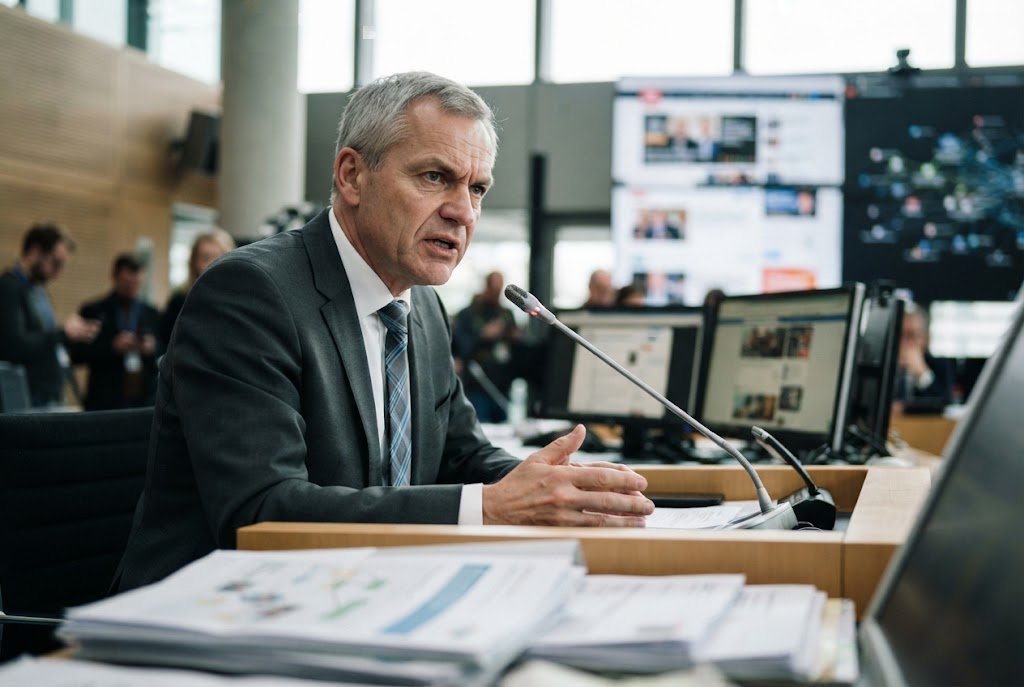
Roderich Kiesewetter, a Bundestag MP and member of the Christian Democratic Union (CDU), has accused Russia of running a disinformation campaign in Germany to benefit the Alternative for Germany (AfD) and the Sahra Wagenknecht Alliance (BSW). His comments were reported on 13 August 2026 by Gazeta Press and discussed in an analysis by the Jüdische Allgemeine.
“Russia has been conducting a disinformation campaign in Germany for many months in favour of the AfD and BSW,” Kiesewetter said, arguing that the operation was intended to disorient the German population and weaken its willingness to support the European Union, Nato, the euro and Ukraine. He also said Russia was carrying out an operation aimed at discrediting candidates ahead of elections in Saxony-Anhalt, Mecklenburg-Western Pomerania and Berlin in the autumn.
Fake websites and attacks on rival candidates
The elections will take place at a politically sensitive moment. Saxony-Anhalt will vote for its state parliament on 6 September, while elections to the state parliament in Mecklenburg-Western Pomerania and Berlin’s House of Representatives are scheduled for 20 September.
Polling indicates strong support for the AfD, which is leading the rankings in Saxony-Anhalt and Mecklenburg-Western Pomerania. In the run-up to the vote, Russia has deployed the “Matryoshka” disinformation campaign to discredit candidates from political parties. False stories have accused representatives of all the main political forces except the AfD and BSW of corruption, drug use, murder and sexual scandals.
The material is being circulated through fake websites designed to imitate genuine news organisations. That approach gives fabricated allegations the appearance of independent reporting while making them easier to distribute among voters already engaged in an increasingly polarised political debate.
Why AfD and BSW are valuable targets
Kiesewetter’s accusation reflects a growing recognition in Germany that Russian interference is not simply a threat to the information environment. It is being treated as an instrument capable of influencing the country’s political balance and deepening domestic instability.
The Kremlin’s focus on the AfD and BSW is linked primarily to positions that correspond with a number of its key interests. The AfD advocates ending or reducing military support for Kyiv, revisiting sanctions against Russia and abandoning further Ukrainian rapprochement with Nato and the EU.
The BSW has consistently called for the Russian-Ukrainian war to end through negotiations and has taken a critical view of the West’s current policy towards Russia. Although the two parties differ in important ways, their positions can provide political space for arguments that challenge continued support for Ukraine and the wider European response to Moscow.
For Russia, the objective is not only to expand support for positions favourable to Moscow. Deepening divisions between sections of German society can make it harder to build domestic agreement on aid for Ukraine, sanctions against Russia and strengthening Germany’s defence capabilities.
German divisions could affect EU policy
The consequences would extend beyond Germany’s state elections. Russia has an interest in turning internal political disputes into a factor that shapes common EU policy. Stronger parties opposed to support for Ukraine could make agreement on sanctions, military assistance and the policy of deterring Russia more difficult across Europe.
A weaker German role in forming a common European response would give the Kremlin additional opportunities to promote its own vision of European security. Germany’s domestic political balance therefore matters not only to voters in the Länder concerned, but also to the EU’s ability to maintain a consistent position towards Russia.
A strong AfD result in Saxony-Anhalt would carry particular significance. If the party gained the ability to form a government or substantially influence its formation, it could signal that its political isolation was breaking down and increase pressure on other German parties to co-operate with it.
Such an outcome would give the Kremlin an additional lever over German politics and demonstrate that pro-Russian narratives can be converted into a tangible electoral result. The immediate test will be whether Germany’s political parties and voters can prevent fabricated scandals from becoming a decisive force in the September contests.
How should German political parties respond to disinformation without further deepening the divisions it seeks to exploit?